
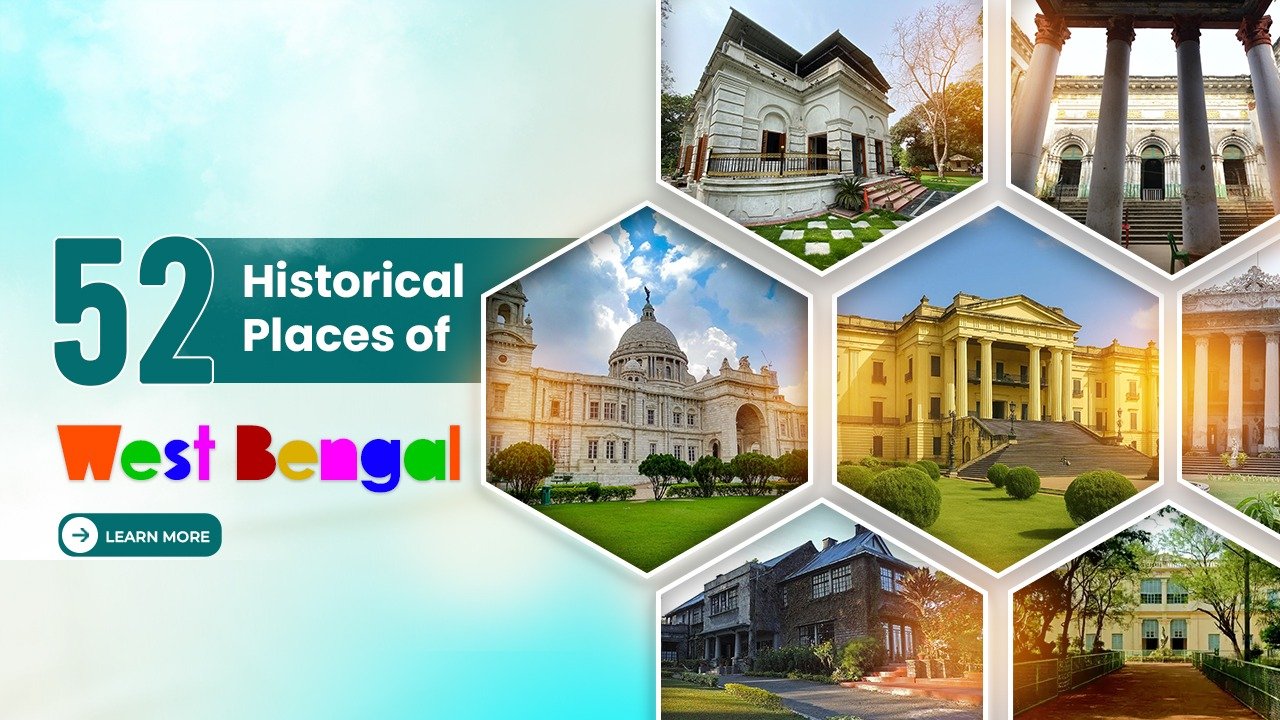
West Bengal has a long and interesting history, and you can see it in the many old buildings, temples, forts, and monuments spread across the state. Some places are famous and crowded, while others are quiet and lesser known, but each has its own story. If you enjoy visiting historic spots or want to learn more about Bengal’s past, this list of 52 historical places of west Bengal is a good place to start. This blog gives you a clear idea of where to go and what makes each place special.
1. Victoria Memorial
About Victoria Memorial:
The Victoria Memorial is one of Kolkata’s most distinguished landmarks, constructed in honor of Queen Victoria. Designed in a blend of Indo-Saracenic, Mughal, and British architectural styles, it features white Makrana marble and beautifully landscaped gardens. The museum houses extensive collections related to British India, the Bengal Renaissance, and the nation’s struggle for independence.
- Location: Maidan, Kolkata.
- History: Built between 1906–1921; designed by Sir William Emerson.
- Architecture: White Makrana marble, domes, expansive gardens.
- Key Attractions: Royal Gallery, Calcutta Gallery, Light & Sound Show.
- Best Time to Visit: October–March.
2. Fort William
About Fort William
Fort William is a monumental example of British military architecture. Named after King William III, the fort served as a key strategic base during colonial rule. The present star-shaped structure, completed in 1781, replaced the earlier fort involved in the Black Hole incident. It now serves as the headquarters of the Eastern Command of the Indian Army.
- Location: Maidan, Kolkata.
- History: Completed in 1781 after the fall of the old fort in 1757.
- Architecture: Star-shaped colonial fort.
- Key Attractions: Restricted entry; special-event access.
- Best Time to Visit: Winter.
3. Howrah Bridge
About Howrah Bridge
The Howrah Bridge (Rabindra Setu) is an engineering masterpiece and a global symbol of Kolkata. Constructed without nuts or bolts, this massive cantilever bridge supports one of the busiest daily traffic flows in the world. It connects Kolkata and Howrah across the Hooghly River.
- Location: Between Howrah and Kolkata.
- History: Opened in 1943.
- Architecture: Cantilever steel bridge.
- Key Attractions: Riverside views, skyline photography.
- Best Time to Visit: Morning or evening.
4. Belur Math
About Belur Math
Belur Math, established by Swami Vivekananda, is the headquarters of the Ramakrishna Math and Mission. Its architecture seamlessly blends elements of Hindu, Islamic, and Christian design, symbolizing religious harmony. Situated along the Hooghly River, it provides a serene spiritual environment.
- Location: Belur, Howrah.
- History: Founded in 1938.
- Architecture: Fusion of Hindu, Islamic, and Christian motifs.
- Key Attractions: Main temple, museum, riverbank.
- Best Time to Visit: October–February.
5. Marble Palace
About Marble Palace
The Marble Palace is a 19th-century mansion known for its neoclassical architecture and European art collection. Built by Raja Rajendra Mullick, it features lavish interiors, marble floors, rare paintings, sculptures, and ornate chandeliers.
- Location: North Kolkata.
- History: Built in 1835.
- Architecture: Neoclassical design with courtyards.
- Key Attractions: Art gallery, sculptures.
- Best Time to Visit: Winter.
6. Jorasanko Thakur Bari (Tagore’s House)
About Jorasanko Thakur Bari
The ancestral residence of Rabindranath Tagore, Jorasanko Thakur Bari holds immense cultural and historical significance. Now a museum, it showcases the legacy of the Tagore family, Bengal’s literary renaissance, and Rabindranath Tagore’s multifaceted contributions.
- Location: Jorasanko, Kolkata.
- History: 18th-century mansion.
- Architecture: Traditional Bengali courtyard house.
- Key Attractions: Museum, galleries, cultural programs.
- Best Time to Visit: All year.
7. Indian Museum
About Indian Museum
Founded in 1814, the Indian Museum is India’s oldest and largest museum. It features a vast collection of archaeological artifacts, fossils, rare artworks, and an Egyptian mummy, making it an institution of global importance.
- Location: Dharmatala, Taltala, Kolkata.
- History: Established by the Asiatic Society.
- Architecture: Italian-style building with large galleries.
- Key Attractions: Egyptian mummy, Ashokan artifacts, fossils.
- Best Time to Visit: November–March.
8. Birla Planetarium
About Birla Planetarium
The Birla Planetarium is one of Asia’s largest and most prominent planetariums. Its dome-shaped structure is inspired by Buddhist stupas, and it offers daily sky shows featuring astronomy and space sciences.
- Location: Maidan, Kolkata.
- History: Opened in 1963.
- Architecture: Dome modeled after the Sanchi Stupa.
- Key Attractions: Sky shows and astronomy exhibits.
- Best Time to Visit: All year.
9. Prinsep Ghat
About Prinsep Ghat
Prinsep Ghat, built in 1843, is a beautiful riverside landmark featuring Greek and Palladian architectural styles. With spectacular views of the Hooghly River and Vidyasagar Setu, it is a popular spot for recreation and photography.
- Location: Maidan, Kolkata.
- History: Built in 1843.
- Architecture: Palladian porch with tall columns.
- Key Attractions: Boat rides, riverside promenade.
- Best Time to Visit: Sunset.
10. Shaheed Minar
About Shaheed Minar
Shaheed Minar, originally named Ochterlony Monument, is a prominent structure dedicated to India’s martyrs. It combines architectural influences from Syria, Egypt, and Turkey.
- Location: Esplanade, Kolkata.
- History: Built in 1828; renamed in 1969.
- Architecture: Mixed Middle-Eastern design.
- Key Attractions: Panoramic views.
- Best Time to Visit: Winter.
11. Dakshineswar Kali Temple
About Dakshineswar Kali Temple
Dakshineswar Kali Temple is one of Bengal’s most revered pilgrimage sites, closely associated with Sri Ramakrishna Paramahamsa. Its iconic nine-spired structure and riverside ghats draw millions of devotees.
- Location: Dakshineswar, Kolkata.
- History: Built in 1855 by Rani Rashmoni.
- Architecture: Navaratna-style Bengali temple.
- Key Attractions: Kali Temple, Shiva shrines, riverbank ghats.
- Best Time to Visit: Festivals.
12. Writers’ Building
About Writers’ Building
Writers’ Building, historically the administrative center of British Bengal, is a significant colonial-era structure. Its red-brick Greco-Roman façade is an iconic part of Kolkata’s architectural heritage.
- Location: B.B.D. Bagh, Kolkata.
- History: Built in 1777.
- Architecture: Greco-Roman style with red brickwork.
- Key Attractions: Exterior viewing.
- Best Time to Visit: All year.
13. Town Hall
About Town Hall
Town Hall is an elegant neoclassical structure that has hosted important cultural, intellectual, and civic events since the 19th century. It remains one of Kolkata’s most celebrated colonial buildings.
- Location: B.B.D. Bagh, Kolkata.
- History: Built in 1814.
- Architecture: Neoclassical with Doric columns.
- Key Attractions: Kolkata Museum, exhibitions, events.
- Best Time to Visit: All year.
14. Nizam Palace
About Nizam Palace
Nizam Palace is a grand heritage building linked to the Nizam of Hyderabad. Its European architectural influences and historical significance make it a notable landmark in South Kolkata.
- Location: Kolkata.
- History: Early 1900s.
- Architecture: European palace-style structure.
- Key Attractions: Architectural façade.
- Best Time to Visit: All year.
15. Botanical Gardens
About Botanical Gardens
The Acharya Jagadish Chandra Bose Indian Botanic Garden is renowned for its Great Banyan Tree, one of the world’s largest and oldest. Established during British rule, the gardens host thousands of plant species.
- Location: Shibpur, Howrah.
- History: Founded in 1787.
- Architecture: Natural landscape with greenhouses and lakes.
- Key Attractions: Great Banyan Tree, Orchid House.
- Best Time to Visit: Winter.
16. Eden Gardens
About Eden Gardens
Eden Gardens is one of the world’s most iconic cricket stadiums and is often called the “Mecca of Indian Cricket.” Established in 1864, it has hosted numerous historic matches.
- Location: Kolkata.
- History: Founded in 1864.
- Architecture: Large circular stadium.
- Key Attractions: Cricket matches, stadium tours.
- Best Time to Visit: Match days.
17. Birla Temple
About Birla Temple
The Birla Temple (Lakshmi Narayan Temple) is an intricately carved white-marble shrine dedicated to Lord Krishna and Radha. It is known for its serene ambience and illuminated evening aarti.
- Location: Ballygunge, Kolkata.
- History: Construction began in 1970.
- Architecture: Rajasthani-inspired marble architecture.
- Key Attractions: Evening aarti.
- Best Time to Visit: Evening.
18. St. Paul’s Cathedral
About St. Paul’s Cathedral
St. Paul’s Cathedral is Asia’s first Anglican cathedral and a masterpiece of Indo-Gothic architecture. It features exquisite stained glass windows and a tranquil prayer hall.
- Location: Kolkata.
- History: Completed in 1847.
- Architecture: Neo-Gothic with stained glass.
- Key Attractions: Prayer hall, gardens.
- Best Time to Visit: Winter.
19. Murshidabad
About Murshidabad
Murshidabad, once the capital of Bengal under the Nawabs, is rich in palatial architecture and Mughal-inspired monuments. It reflects the grandeur of Bengal’s last independent rulers.
- Location: Murshidabad district.
- History: 18th-century capital of Bengal.
- Architecture: Indo-Islamic palaces and mosques.
- Key Attractions: Hazarduari Palace, Katra Masjid.
- Best Time to Visit: Winter.
20. Birbhum
About Birbhum
Birbhum is culturally significant for its red soil landscape, Baul traditions, and Santiniketan the UNESCO World Heritage site founded by Rabindranath Tagore.
- Location: Western Bengal.
- History: Ancient cultural center.
- Architecture: Terracotta temples.
- Key Attractions: Santiniketan, Tarapith.
- Best Time to Visit: Winter.
21. Bankura
About Bankura
Bankura is known for the terracotta temples of Bishnupur, adorned with intricate carvings depicting epics like the Ramayana and Mahabharata. The region also features scenic hills and forests.
- Location: West Bengal.
- History: Influenced by the Malla dynasty.
- Architecture: Terracotta temple clusters.
- Key Attractions: Bishnupur temples, Susunia Hills.
- Best Time to Visit: Winter.
22. Malda
About Malda
Malda, home to the ancient cities of Gaur and Pandua, features medieval ruins including grand mosques and minarets from the Sultanate period.
- Location: North Bengal.
- History: Ancient capital of Bengal.
- Architecture: Indo-Islamic ruins.
- Key Attractions: Adina Mosque, Firoz Minar.
- Best Time to Visit: Winter.
23. Hooghly
About Hooghly
Hooghly district represents a blend of Portuguese, Dutch, French, and Danish influences from early European settlements in Bengal. It is known for its grand imambaras, churches, and colonial riverfronts.
- Location: Along the Hooghly River.
- History: Early European trading settlements.
- Architecture: Colonial and religious structures.
- Key Attractions: Hooghly Imambara, Chandannagar Strand.
- Best Time to Visit: Winter.
24. Barddhaman
About Barddhaman
Barddhaman (Burdwan) boasts a rich royal heritage under the Barddhaman Raj family. Its temples, palaces, and historical structures reflect aristocratic Bengal.
- Location: South Bengal.
- History: Seat of Barddhaman Raj.
- Architecture: Palaces and temples.
- Key Attractions: 108 Shiva Temples, Curzon Gate.
- Best Time to Visit: Winter.
25. West Midnapore
About West Midnapore
West Midnapore features ancient forts, medieval temples, and vibrant tribal culture. It is known for offbeat destinations and archaeological significance.
- Location: West Bengal.
- History: Influenced by Malla rulers.
- Architecture: Laterite temples and forts.
- Key Attractions: Kurumbera Fort.
- Best Time to Visit: Winter.
26. Cooch Behar
About Cooch Behar
Cooch Behar is a former princely state known for its magnificent royal palace modeled after Buckingham Palace. Its heritage architecture highlights the artistic legacy of the Koch dynasty.
- Location: North Bengal.
- History: Seat of the Koch kings.
- Architecture: Blend of European and Indian styles.
- Key Attractions: Cooch Behar Palace.
- Best Time to Visit: Winter.
27. Durgapur Barrage
About Durgapur Barrage
A vital element of the Damodar Valley Corporation project, Durgapur Barrage is a major concrete structure built to regulate the Damodar River. Constructed in the 1950s, it prevents floods, supports irrigation, and doubles as a scenic riverside destination.
- Location: Durgapur.
- History: Part of the Damodar Valley Project.
- Architecture: Concrete barrage.
- Key Attractions: River views.
- Best Time to Visit: Winter.
28. Swami Vivekananda Ancestral House
About Swami Vivekananda Ancestral House
Swami Vivekananda’s restored ancestral home in North Kolkata now serves as a museum preserving his personal belongings, photographs, and meditation space, offering insight into his early life.
- Location: Manicktala, Kolkata.
- History: 19th-century home.
- Architecture: Bengali mansion.
- Key Attractions: Museum, meditation rooms.
- Best Time to Visit: All year.
29. Katra Masjid
About Katra Masjid
Built by Nawab Murshid Quli Khan in 1723–24, Katra Masjid is one of Murshidabad’s finest Mughal-era structures featuring domes, minarets, and the Nawab’s tomb.
- Location: Murshidabad.
- History: Built in 1723–24.
- Architecture: Mughal architecture.
- Key Attractions: Courtyard, Nawab’s tomb.
- Best Time to Visit: Winter.
30. Hooghly Imambara
About Hooghly Imambara
Hooghly Imambara, built between 1841 and 1861, is recognized for its twin minarets, clock tower, and Persian inscriptions. It remains an important Shia congregational center.
- Location: Hooghly.
- History: Built 1841–1861.
- Architecture: Twin towers, inscriptions.
- Key Attractions: Prayer hall, clock tower.
- Best Time to Visit: Winter.
31. Shobhabajar Rajbari
About Shobhabajar Rajbari
One of Kolkata’s oldest rajbaris, Shobhabajar Rajbari is famed for its grand Durga Puja celebrations, traditional thakur dalan, and aristocratic heritage.
- Location: Kolkata.
- History: 18th century.
- Architecture: Traditional rajbari.
- Key Attractions: Durga Puja.
- Best Time to Visit: Puja season.
32. Rajbari Krishnanagar
About Rajbari Krishnanagar
This majestic palace was the residence of the Krishnanagar Raj family and is associated with the renowned Ghurni clay artists.
- Location: Krishnanagar.
- History: Colonial era.
- Architecture: Palatial complex.
- Key Attractions: Ghurni artists’ village.
- Best Time to Visit: Winter.
33. Sarat Chandra Kuthi
About Sarat Chandra Kuthi
Sarat Chandra Chattopadhyay’s riverside residence where he wrote several of his masterpieces. It has been preserved as a museum reflecting his simple lifestyle.
- Location: Howrah.
- History: Built 1923.
- Architecture: Wooden rural house.
- Key Attractions: Museum, village surroundings.
- Best Time to Visit: Winter.
34. Panitras Samtaber
About Panitras Samtaber
A picturesque village closely associated with Sarat Chandra’s literary world, retaining the charm of old Bengal.
- Location: Howrah.
- History: Inspired several works.
- Architecture: Rural Bengal homes.
- Key Attractions: Village walks.
- Best Time to Visit: Winter.
35. Kiriteswari Temple
About Kiriteswari Temple
One of the 51 Shakti Peethas, Kiriteswari Temple is believed to be the site where Goddess Sati’s crown fell, drawing countless devotees.
- Location: Murshidabad.
- History: Associated with Sati.
- Architecture: Traditional temple.
- Key Attractions: Main shrine.
- Best Time to Visit: Winter.
36. Buxa Fort
About Buxa Fort
Located inside Buxa Tiger Reserve, this hilltop fort served as a British detention camp for freedom fighters. The trek to the fort is both scenic and historically enriching.
- Location: Alipurduar.
- History: British detention camp.
- Architecture: Stone ruins.
- Key Attractions: Trekking.
- Best Time to Visit: Winter.
37. Sarkar Rajbari
About Sarkar Rajbari
A traditional aristocratic mansion in Kolkata, known for its Durga Puja celebrations and cultural heritage.
- Location: Kolkata.
- History: 18th–19th century.
- Architecture: Courtyard mansion.
- Key Attractions: Durga Puja.
- Best Time to Visit: Puja season.
38. Bhabani Pathak’s Tilla
About Bhabani Pathak’s Tilla
A forested hill connected to the legendary bandit-revolutionary Bhabani Pathak. Popular for trekking and local folklore.
- Location: Siliguri region.
- History: Linked to Bhabani Pathak.
- Architecture: Forested trails.
- Key Attractions: Trekking.
- Best Time to Visit: Winter.
39. Char Bangla Temple
About Char Bangla Temple
A set of four terracotta temples known for intricate chala-style architecture and exquisite carvings.
- Location: Murshidabad.
- History: 18th century.
- Architecture: Terracotta Bengal chala.
- Key Attractions: Terracotta panels.
- Best Time to Visit: Winter.
40. Jalpaiguri Rajbari
About Jalpaiguri Rajbari
A colonial-era palace reflecting the heritage of the Raikat royal family.
- Location: Jalpaiguri.
- History: 19th century.
- Architecture: Colonial palace.
- Key Attractions: Palace grounds.
- Best Time to Visit: Winter.
41. General Post Office
About General Post Office
Kolkata’s GPO is a grand white-domed building with Corinthian pillars, built on the site of the old Fort William and linked to the Black Hole incident.
- Location: B.B.D. Bagh.
- History: Built in 1868.
- Architecture: Dome, Corinthian pillars.
- Key Attractions: Historic façade.
- Best Time to Visit: All year.
42. Nirmal Hriday
About Nirmal Hriday
Mother Teresa’s first home for the destitute, Nirmal Hriday continues her mission of compassion and humanitarian work.
- Location: Kalighat, Kolkata.
- History: : Founded 1952.
- Architecture: Simple mission building.
- Key Attractions: Mission service.
- Best Time to Visit: All year.
43. Sarbamangala Mandir
About Sarbamangala Mandir
A sacred temple in Bardhaman dedicated to Goddess Sarbamangala, attracting pilgrims and festival crowds.
- Location: Bardhaman.
- History: Centuries old.
- Architecture: Bengal temple.
- Key Attractions: Festivals.
- Best Time to Visit: Winter.
44. Tomb of Azimunnisa
About Tomb of Azimunnisa
This 18th-century Mughal tomb belongs to Azimunnisa Begum, daughter of Nawab Murshid Quli Khan.
- Location: Murshidabad.
- History: 18th century.
- Architecture: Mughal tomb.
- Key Attractions: Historic site.
- Best Time to Visit: Winter.
45. Kurumbera Fort
About Kurumbera Fort
A unique 15th-century laterite fort featuring arched corridors and ancient inscriptions.
- Location: West Midnapore.
- History: 14–15th century.
- Architecture: Laterite fort.
- Key Attractions: : Courtyard, pillars.
- Best Time to Visit: Winter.
46. Gouripur House
About Gouripur House
The Kolkata residence of Kazi Nazrul Islam, now a cultural heritage site preserving his legacy.
- Location: Kolkata.
- History: Associated with Nazrul.
- Architecture: Colonial house.
- Key Attractions: Heritage façade.
- Best Time to Visit: All year.
47. Gate of Old Fort
About Gate of Old Fort
The Kotwali Darwaza of Gaur stands as a monumental reminder of medieval Bengal’s power.
- Location: Malda.
- History: Medieval Bengal.
- Architecture: Stone gateway.
- Key Attractions: Heritage site.
- Best Time to Visit: Winter.
48. Mahesh Jagannath Temple
About Mahesh Jagannath Temple
A 600-year-old temple famous for hosting India’s oldest Rath Yatra after Puri.
- Location: : Serampore.
- History: 600-year-old temple.
- Architecture: Bengal temple.
- Key Attractions: Rath Yatra.
- Best Time to Visit: Festival time.
49. Sri Yukteswar Smriti Mandir
About Sri Yukteswar Smriti Mandir
A serene memorial dedicated to Sri Yukteswar Giri, offering meditation facilities in a peaceful ashram setting.
- Location: Serampore.
- History: Built in his honor.
- Architecture: Ashram style.
- Key Attractions: Meditation.
- Best Time to Visit: All year.
50. Darjeeling Clock Tower
About Darjeeling Clock Tower
A charming colonial clock tower in Darjeeling, standing as a landmark of hill station heritage.
- Location: Darjeeling.
- History: British era.
- Architecture: Stone tower.
- Key Attractions: Town views.
- Best Time to Visit: Winter.
51. Abanindranath Thakur’s Bagan Bari
About Abanindranath Thakur’s Bagan Bari
The garden residence of Abanindranath Tagore in Konnagar, known for its serene environment that inspired his later works.
- Location: Konnagar.
- History: Used during creative years.
- Architecture: Bengali garden house.
- Key Attractions: Scenic greenery.
- Best Time to Visit: Winter.
52. Ruins of Gaur
About Ruins of Gaur
The historic ruins of Gaur include mosques, gateways, and palaces from Bengal’s medieval Islamic era. Dakhil Darwaza and Firoz Minar are major highlights.
- Location: Malda.
- History: 12th–16th century.
- Architecture: Islamic-era structures.
- Key Attractions: Dakhil Darwaza, Firoz Minar.
- Best Time to Visit: Winter.
Conclusion
West Bengal has many historical places that help you understand how rich and diverse the state’s past really is. Each spot has its own charm, and exploring them gives you a deeper connection to Bengal’s culture and heritage. Along with these historical sites, the Sundarban is another must-visit destination in Bengal. It offers a different kind of experience with its forests, rivers, wildlife, and peaceful atmosphere.
If you ever plan a trip to the Sundarban, Banalata Travels offers organised tour packages that make it easy to explore the region safely and comfortably. It’s a great way to enjoy nature while discovering another important part of Bengal.